Erik ten Hag has laid out the foundations for his side over the course of this pre-season. It appears as though he will be building on Ole Gunnar Solskjaer’s side and using a similar setup to his. One very effective side which you can find parallels with is the Tottenham Hotspur side of 2016/17; a side, which even though they failed to win anything, every Tottenham fan continues to rave about. How could Erik ten Hag use Pochettino’s tactics and emulate such an effective side.
Tottenham Hotspurs (Spurs) set-up in a 4-2-3-1 mid-block, their defense consisted of excellent ball players in Jan Vertonghen and Toby Alderweireld. The partnership was one of the best in the league, both defensively and in-possession. You can already draw similarities with the Martinez-Maguire partnership we will most likely see this season, as the pair are excellent on the ball and will help to progress play effectively.
The side also utilized fast, technical, attacking fullbacks. Ten Hag has come in and done just that, Shaw’s power down the left will be key to our chance creation, as well as Dalot’s speed and intricate play within the inverted role. The pair will be involved in most things that United do well this season.
Pochettino set out to use two powerhouses in midfield: Victor Wanyama and Moussa Dembele. Don’t get me wrong, the pair were very technical, Dembele was one of the best centre-midfielders that the league has seen recently. However, the pair used their physicality very effectively, cleaning up when the front four turned over possession and keeping Spurs on the front foot in matches.
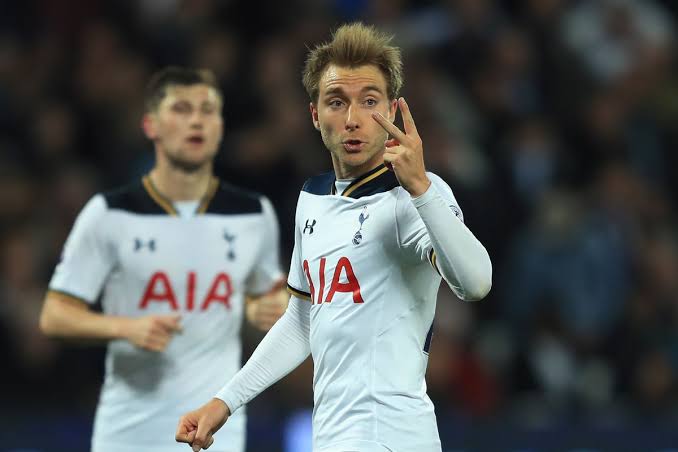
There was a very interesting setup with the front four, something that Manchester United could do this season. It involved no two players having the same role, Tottenham did not use two inside forwards or wingers this season even though they played a wide formation. Instead, they utilized playmaker Christian Eriksen in a ‘wide’ playmaking role on the right of the Tottenham attack.

As you can imagine, there were doubts about Eriksen’s ability to play the role, however his fitness and athleticism was at the top of its game and he never found himself in positions where he’d have to take on opponents one on one. His numbers that season outline the success of using him in that role, 8 goals and 15 assists in 36 Premier League games is an impressive return.
He wasn’t a high-volume passer, he averaged around 44 per game, but he was a high-volume chance creator, and his ability on either foot had a big part to play. As a two-footed player, you are able to access many more passing and shooting angles since you can play the ball on either foot. Eriksen was able to run infield from a wide position and play a pass through on his left, similar to how Ozil would play line-breaking passes, or he could receive the ball in a half-space and deliver it into the box, exactly how he did during Spurs’ 2-0 win against Chelsea.

Eriksen received a cut back pass from Walker before this image. Eriksen has brilliant awareness, constantly scanning, and since he was in space, he had time to find the pass to Dele Alli, whilst he could’ve also played it to Danny Rose who was attacking the back post. I expect him to play a very similar role for Manchester United, and it would be Bruno and Rashford on the end of a ball like this.
Dele Alli
Dele Alli had the season of his career in the 16-17 Premier League campaign, it would be very hard for him to reach that level of performances again with the way his career is turning out. Alli scored 18 goals and assisted 7 times across 37 matches, a very impressive record for his full first season in the Premier league.
Alli played as a second-striker that season, he would leave the midfield space open and push on, occupying spaces that Kane would. This tactical tweak alongside the decision to play Eriksen in a wider role is what made the system work, as when Alli would push on forward, Eriksen was able to drift into the middle space and create chances.

As seen by his heatmap, there were numerous occasions where he was in the opposition penalty area and even had orange patches inside the 6-yard box. His ability to find and get into space worked well for Spurs as they were able to constantly find him with crosses in and around the box. Alli averaged 2.5 shots per game with a conversion rate of 19%, very similar to Bruno Fernandes in 20/21 (3.3 shots per game with a 15% conversion rate).

Now, judging it off his heatmap, I wouldn’t quite classify Bruno as a second striker, although at times it may appear that he plays like one. Bruno is a very high playmaker who often works his way into the channels to support attacks on either side of the pitch.
A key similarity between him and Dele’s heatmap is the amount of orange patches inside the penalty area, both midfielders work well when they are used higher up due to their excellent ball striking ability. Bruno also found himself around the box much more, usually creating chances for Cavani who was inside the box.

Very similar to Alli, Bruno takes on lots of shots inside the penalty area box, but tends to take more on from outside the box (matches his heatmap as he didn’t play as high as Alli). He also exceeded his xG by 1.98, compared by Alli who exceeded it by 3.29. xG is a great measure of how good his shots were, and the pair are both excellent finishers inside the area.
Another player that can play this role is Donny Van de Beek. The raumdeuter likes to find and ‘invade’ space on the pitch, hence the English translation, space invader. He’s somewhere who is able to find pockets of space and play in tight areas, as well as being a 3rd man runner who arrives into the box and scores goals.
In the 18/19 Eredivisie campaign, Donny would take 36.7 touches p90 and complete 20.6 passes p90, much less than 54.8 touches p90 and 29 accurate passes. That’s an area that Van de Beek needs to improve in since he doesn’t impose himself on the game and often goes missing out of the match.
He scored 9 goals that season, and missed 9 big chances, which is perhaps a concern since Bruno appears to be doing much better than that in a harder league. For this tactical setup to work, he must play as a second striker effectively and be amongst the high scorers in the league.
However, even with his suitability for the role and the fact that he’s worked with ten Hag before, I still believe that Van de Beek will be a bench player this season as he’s failing to take his chances.
I strongly feel that there is a possibility that ten Hag’s system for the season ahead could emulate and be almost identical to Pochettino’s in the 16/17 league campaign. The signings of Malacia, Martinez and Eriksen will seriously bolster his side, with a deal looming for Frenkie de Jong. Ten Hag must find the correct balance in attack this season use players that will fit his system, not ones that the board are forcing onto him as it will only lead to further failure.
He must also ensure that he succeeds in the one area that the Spurs side failed in, winning trophies. Ultimately, his job depends on him winning trophies, so he must build a system effective enough to allow the side to challenge and win trophies.


